

What Is Doomjobbing? The Viral Job Search Burnout Trend Explained
What is doomjobbing? Discover the meaning behind the viral corporate jargon term describing endless job applications, rejection emails, LinkedIn burnout, and modern hiring exhaustion.

Introduction
The term “doomjobbing” is suddenly everywhere online — especially among young professionals already exhausted by endless applications, ghosted interviews, rejection emails, and the pressure to perform on LinkedIn constantly.
Like doomscrolling, doomjobbing traps people in a repetitive cycle:
- Apply for jobs
- Refresh inbox
- Hear nothing
- Question your entire existence
- Repeat tomorrow
And somehow… this has become normal.
Recent discussions on LinkedIn and other online platforms describe doomjobbing as the modern job-search spiral — a cycle of compulsively applying for jobs while confidence slowly erodes.
What Does “Doomjobbing” Mean?
Doomjobbing describes the emotionally draining habit of endlessly searching and applying for jobs while becoming increasingly hopeless about the process.
It combines:
- Doomscrolling
- Job hunting
- Burnout
- Career anxiety
- LinkedIn obsession
- Rejection fatigue
In simple terms:
Applying for jobs until your soul leaves your body.
21 Signs You’ve Entered the Doomjobbing Phase
1. You refresh LinkedIn more than your messages
Because maybe THIS time someone noticed you.
2. You can recognise rejection email templates instantly
You already know the outcome from the first line.
3. “We’ll keep your CV on file” feels personal now
They absolutely won’t.
4. You’ve rewritten your CV so many times it no longer resembles reality
You’re now:
- Strategic
- Dynamic
- Results-driven
- Emotionally collapsing
5. You apply for jobs you don’t even want anymore
At this point, it’s muscle memory.
6. Every job listing somehow wants 7 years’ experience for entry-level pay
Naturally.
7. You begin treating LinkedIn like a survival simulator
“Thrilled to announce…” posts become psychological warfare.
8. You secretly hate anyone posting career success stories
Especially the “dream role secured!” people.
9. You’ve started checking job boards late at night
Classic doomjobbing behaviour.
10. You apply for roles while emotionally exhausted
Because stopping feels worse.
11. “Easy Apply” has destroyed your brain chemistry
One click.
Zero responses.
12. You’ve considered becoming:
- A barista
- A goat farmer
- A digital nomad
- A pottery instructor
- Literally anything else
13. Recruiters suddenly vanish mid-conversation
Like corporate ghosts.
14. You start questioning your entire career path
Maybe your degree was just decorative.
15. Your confidence drops after every ignored application
And rebuilding it takes longer each time.
16. You spend more time searching than living
That’s the dangerous part.
17. Every “Unfortunately…” email feels identical
Because it is.
18. You refresh your inbox with irrational optimism
Despite all evidence.
19. You can no longer tell whether you’re networking or begging
Modern professionalism is confusing.
20. You feel guilty when not applying
Even when you desperately need a break.
21. You realise the process itself is burning people out
And suddenly the term makes perfect sense.
Why Doomjobbing Happens
The modern hiring process is a perfect storm of:
- AI screening tools
- Mass online applications
- Automated rejection systems
- Ghosting by employers
- LinkedIn comparison culture
- Economic uncertainty
- Endless “hustle” pressure
Recent commentary from recruiters and professionals online suggests morale among job seekers is now lower than many have ever seen it. Some recruiters describe candidates as becoming emotionally exhausted far earlier in the process than before.
The Guardian recently described doomjobbing as:
“doomscrolling, but for job ads.”
Honestly?
That’s painfully accurate.
What Doomjobbing Actually Does to People
This is where the joke stops being funny.
Doomjobbing slowly creates:
- Anxiety
- Self-doubt
- Emotional exhaustion
- Loss of confidence
- Comparison obsession
- Constant stress
You begin measuring your self-worth through:
- interview invites
- recruiter replies
- application numbers
- LinkedIn engagement
And that’s dangerous.
Because silence in hiring processes often says more about broken systems than about the person applying.
The Corporate Jargon Johnson Translation
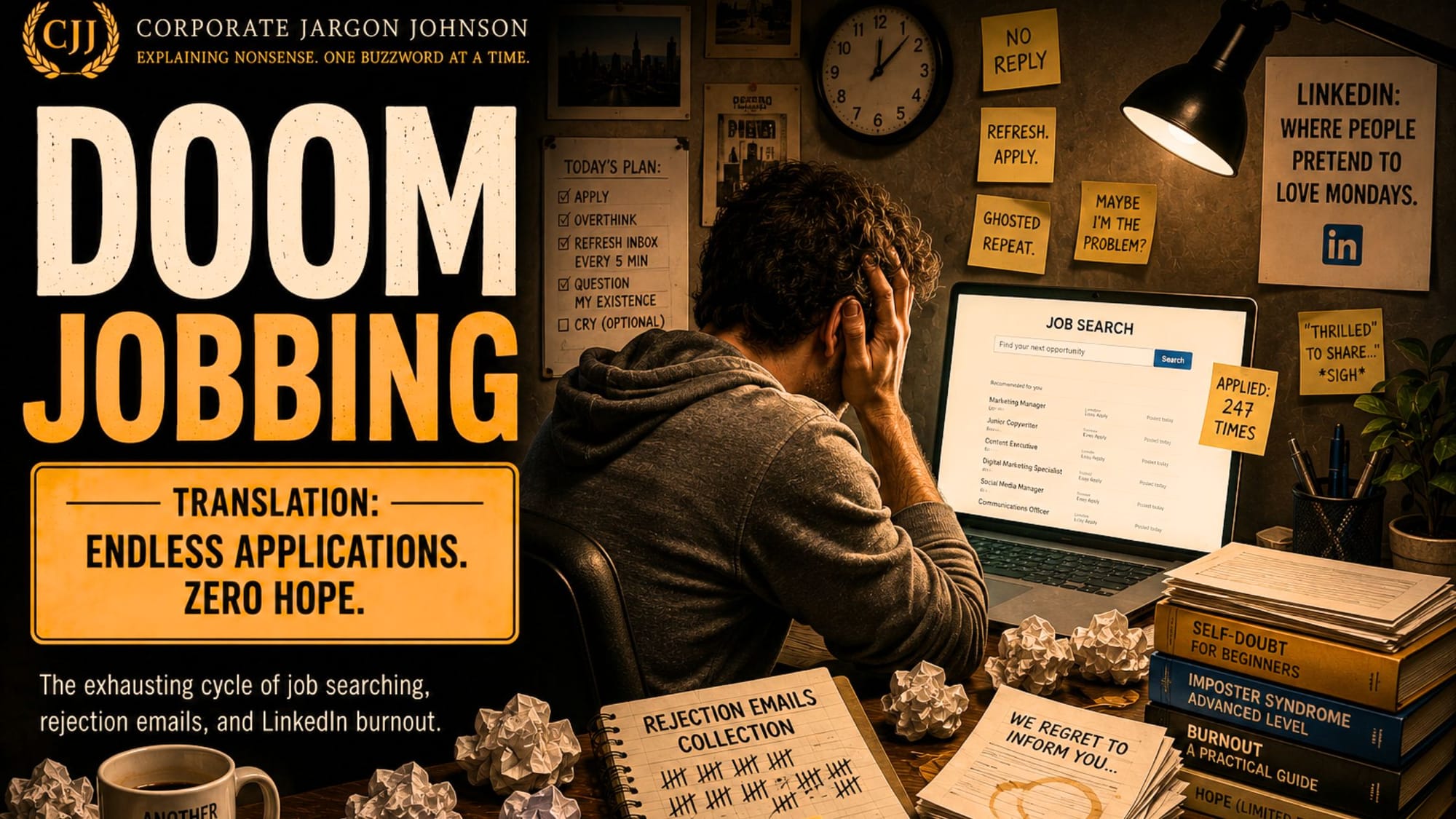
Doomjobbing
Translation: Endless applications. Zero hope.
How to Survive Doomjobbing Without Losing Your Mind
Stop measuring productivity by the number of applications
100 weak applications will destroy you faster than 5 strong ones.
Set time limits
Job hunting should not consume every waking hour.
Stop doomscrolling LinkedIn
Half the platform is:
- Personal branding theatre
- Recycled motivation quotes
- People pretending they’re thriving
Take breaks without guilt
Burnout destroys interview performance.
Focus on real human connections
The internet makes job searching feel mechanical.
People still matter more than algorithms.
Remember this:
Being ignored by automated systems does NOT define your value.
Don’t Let Doomjobbing Convince You You’re Worthless
Here’s the dangerous part about doomjobbing:
After enough ignored applications, ghosted interviews, and automated rejection emails, people start blaming themselves for a broken process.
But modern hiring is often:
- chaotic
- overcrowded
- algorithm-driven
- emotionally exhausting
- painfully impersonal
Being ignored by a system does not mean you lack talent, intelligence, or value.
Sometimes it means:
- The role was flooded with applicants
- The company already had an internal candidate
- AI-filtered applications badly
- Recruiters were overwhelmed
- Hiring freezes happened halfway through
And sometimes…
The process genuinely just sucks.
Keep Going — Even If the Process Feels Broken
You only need:
- One good opportunity
- One real conversation
- One person who sees your value
That’s it.
Most successful careers are built through persistence during periods where absolutely nothing seems to be happening.
The silence is brutal.
The waiting is exhausting.
But it does not last forever.
Take breaks when you need to.
Protect your confidence.
Step away from LinkedIn occasionally.
And remember:
your worth is bigger than your inbox.
Because eventually…
One of those applications won’t end in silence.
And when that happens, all the rejection emails stop mattering.
Final Thoughts
Doomjobbing isn’t laziness.
It isn’t a weakness.
And it definitely isn’t just “young people complaining.”
It’s what happens when modern hiring becomes:
- automated
- impersonal
- endless
- emotionally draining
People aren’t just job searching anymore.
They’re surviving the process.
And somewhere between the rejection emails, fake optimism, and motivational LinkedIn posts…
A whole generation started burning out before they even got hired.
Frequently Asked Questions About Doomjobbing
What does doomjobbing mean?
Doomjobbing describes the repetitive cycle of endlessly applying for jobs online while becoming emotionally exhausted and hopeless about the process.
Is doomjobbing the same as doomscrolling?
Not exactly. Doomscrolling involves endlessly consuming negative content online, while doomjobbing focuses specifically on job searching and application burnout.
Why is doomjobbing becoming more common?
Many people blame AI screening tools, ghosting from employers, highly competitive job markets, and constant LinkedIn pressure.
How do I stop doomjobbing?
Set limits, focus on quality applications instead of quantity, take breaks from LinkedIn, and avoid turning job searching into a 24/7 activity.
Is job-search burnout real?
Yes. Recruiters, career coaches, and professionals increasingly describe job-search burnout as a serious issue affecting confidence, motivation, and mental health.


