

21 Signs You Work With a Dungeons & Dragons Gamer
Meet the Dungeons & Dragons Gamer: the coworker who books leave for conventions, speaks in fantasy references, and turns every meeting into a boss battle. Funny workplace satire.

Some coworkers spend their evenings watching Netflix or talking to their families.
Some spend them raiding dungeons, rolling dice, arguing with goblins, and attempting to seduce dragons.
The Dungeons & Dragons Gamer is usually harmless, surprisingly intelligent, and often one of the most loyal people in the office. However, if you accidentally ask them what they did at the weekend, you may find yourself trapped in a 45-minute explanation involving a cursed sword, three goblins, a rogue called Steve, and a natural 20.
Here are 21 signs you've found one.
21 Signs You Work With a Dungeons & Dragons Gamer
1. Every conversation somehow ends up back at D&D
What started as a discussion about project planning somehow becomes a story about defeating an ancient lich.
2. They book annual leave for gaming conventions
Most people take holidays at the beach. They take holidays for dice.
3. They know release dates better than project deadlines
The launch date of the latest RPG? Instantly remembered. Quarterly reporting deadline? Not so much.
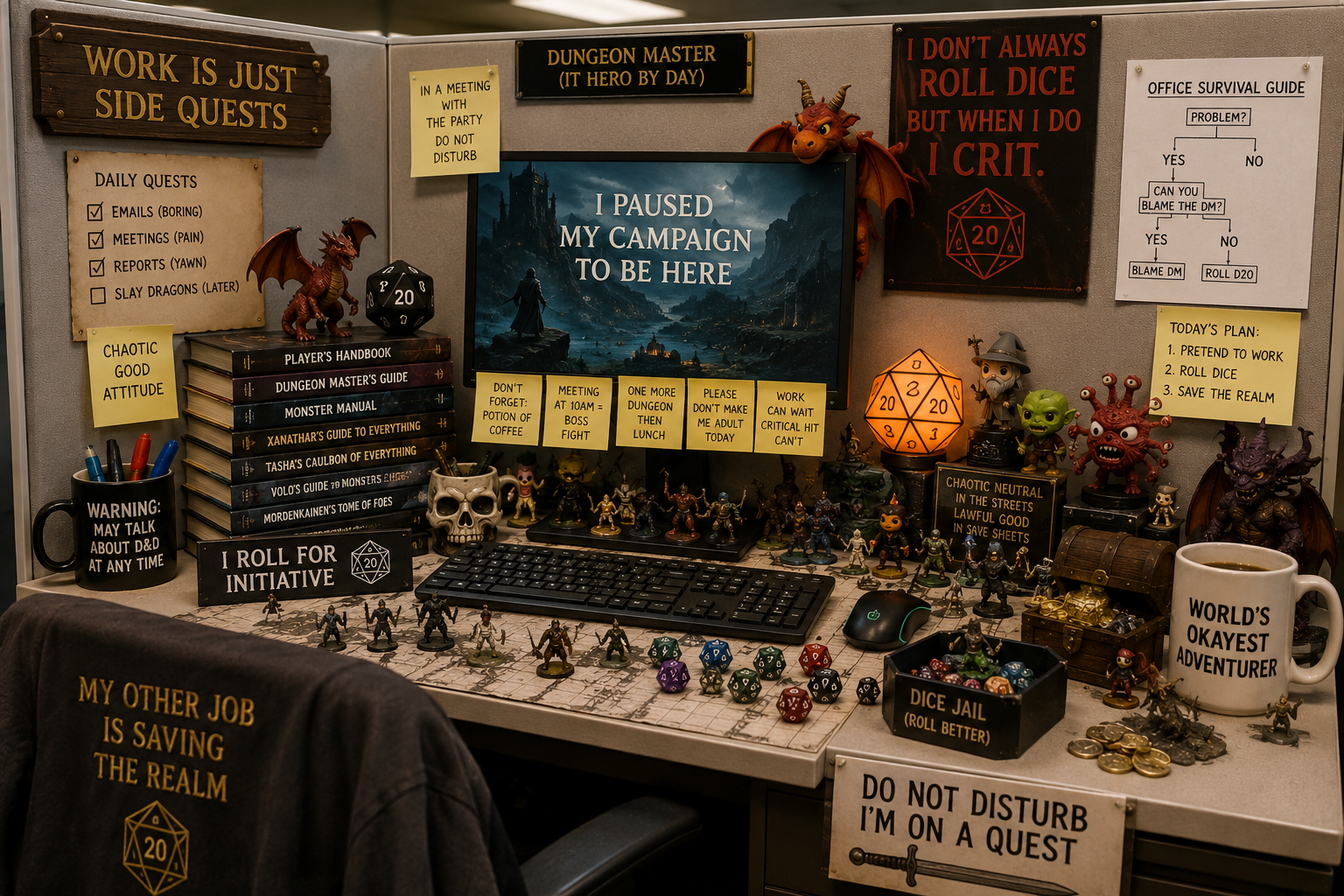
4. Their desk resembles a fantasy gift shop
Miniatures, dragons, dice, maps, and enough fantasy artwork to start a small kingdom.
5. They refer to coworkers as character classes
The finance manager is clearly a Paladin. The sales team are definitely Bards.
6. They have a favourite set of dice
And nobody is allowed to touch them.
7. They become genuinely excited about rulebooks
Most people don't celebrate buying a book with 400 pages of game mechanics.
8. They describe meetings as encounters
"Difficult stakeholder meeting? That's a boss battle."
9. Every problem has a strategic solution
Years of campaign planning have made them surprisingly good problem-solvers.
10. They casually mention campaigns that have lasted years
Longer than some marriages.
11. Their friendship group consists largely of other gamers
They naturally seek out fellow nerds wherever they work.
12. They know every fantasy film ever made
And can tell you which parts were inaccurate.
13. They have an alarming amount of lore knowledge
About fictional worlds that don't exist.
14. They can spend an hour discussing a character build
Without noticing, everyone else has left the room.
15. They refer to luck as rolling a natural 20
Good news at work? Clearly a critical success.
16. They don't use corporate jargon
Instead, they say things like:
- "That's a critical failure."
- "The party isn't aligned."
- "Roll for initiative."
- "This quest has gone off the rails."
- "The DM is definitely against us."
- "That's chaotic neutral behaviour."
- "We're entering boss battle territory."
17. They become suspiciously quiet before game night
Because they're secretly planning something.
18. They probably own more dice than pens
And somehow this makes perfect sense to them.
19. They have opinions about World of Warcraft
Very strong opinions.
20. They secretly enjoy complex spreadsheets
Character sheets are basically fantasy spreadsheets.
21. They are often found in technical roles
Developers, engineers, architects, analysts and IT specialists seem particularly vulnerable to becoming Dungeon Masters.
Why This Happens
Dungeons & Dragons appeals to creativity, strategy, storytelling and problem-solving.
Many gamers are naturally analytical thinkers who enjoy systems, planning and teamwork. Ironically, these same skills often make them valuable employees.
The downside is that not everyone wants to hear a detailed account of how a half-elf ranger defeated a beholder at 11:45 on a Monday morning.
How To Deal With A Dungeons & Dragons Gamer
- Ask questions only if you genuinely have time.
- Never ask how their campaign is going unless you're prepared for a full answer.
- Accept that "just one more story" is rarely just one story.
- Learn what a natural 20 means. It'll save confusion later.
- Respect the dice.
Most importantly, remember that enthusiasm usually comes from a good place.
🗄️ The Confidential Drawer
The Dungeons & Dragons Gamer is rarely one of the toxic characters in the office.
In fact, many are among the most reliable, policy-following and professional employees you'll work with. They generally turn up, do their work properly, avoid office politics and would rather spend their energy discussing fantasy worlds than creating real workplace drama.
Yes, they can sometimes become a little obsessed with campaigns, upcoming game releases, miniature collections or the latest fantasy expansion pack. They may occasionally bore non-gamers with stories about dragons, wizards and critical hits, but their enthusiasm is usually harmless.
One thing many managers discover is that gamers often bring surprisingly useful skills into the workplace:
- Strategic thinking
- Problem solving
- Team collaboration
- Creative thinking
- Project planning
- Risk assessment
- Patience and persistence
Many Dungeon Masters spend years managing groups of difficult personalities, resolving conflicts, organising schedules and keeping projects moving forward. Sound familiar?
If a D&D Gamer ever becomes frustrating, it's usually because they struggle to realise not everyone shares their enthusiasm. A polite change of subject is normally enough.
Verdict: Not a workplace villain. More likely a passionate nerd who occasionally mistakes the office for a tavern quest hub.
❓ Dungeons & Dragons Gamer FAQ
Why are so many gamers found in IT roles?
Many technical roles attract analytical thinkers who enjoy systems, problem-solving, strategy and complex worlds.
Do D&D gamers make good employees?
Often yes. The teamwork, planning and communication involved in gaming can translate surprisingly well into the workplace.
Should managers worry about gaming hobbies?
Not unless it affects performance. For most people, it's simply a hobby like football, golf or watching films.
Why do gamers seek out other gamers at work?
Shared interests create instant friendships. Mention D&D once, and they'll somehow find each other.


