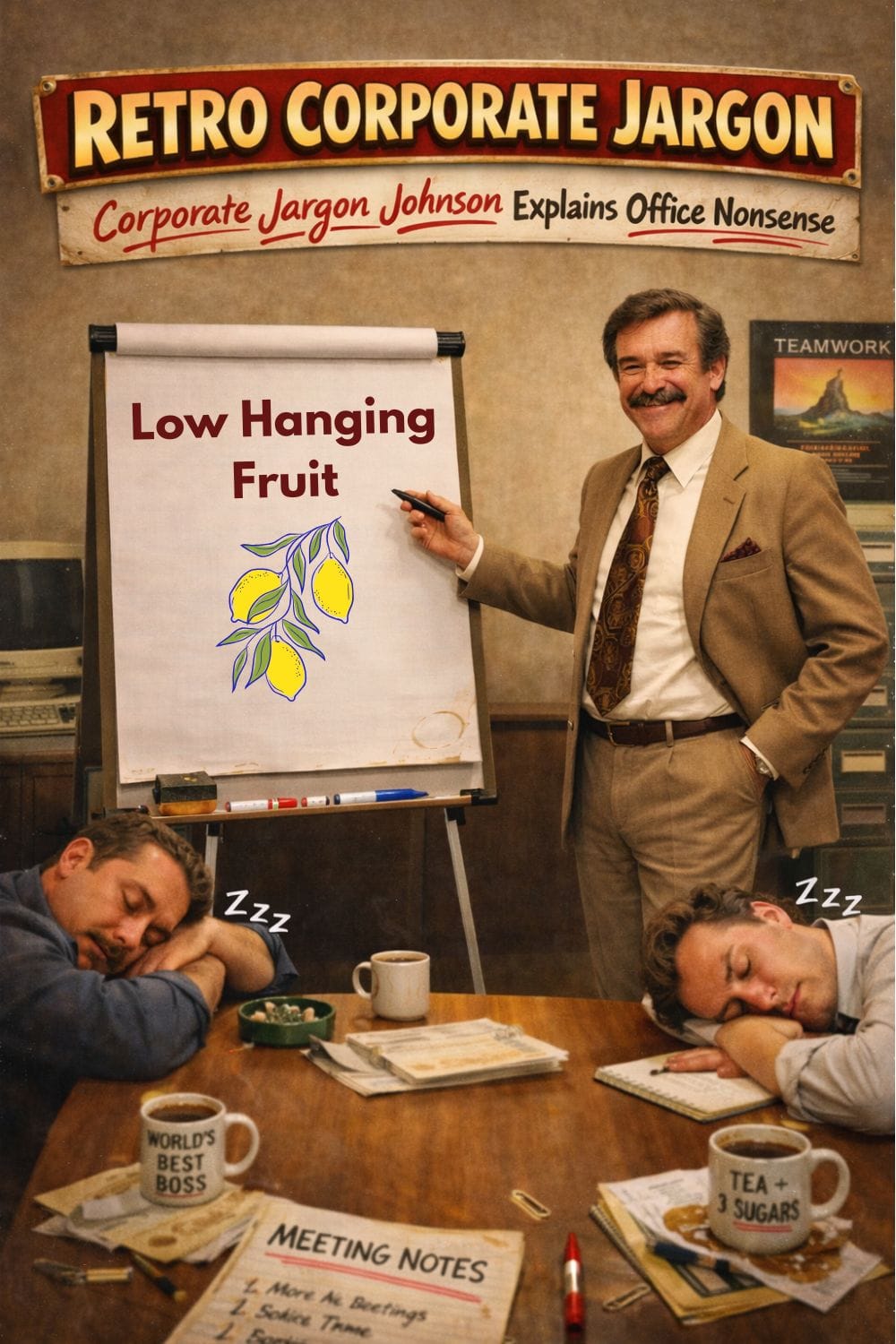

What Does “Low-Hanging Fruit” Mean at Work? (Corporate Jargon Explained)
Corporate jargon explained. Discover what “low hanging fruit” really means at work, why managers focus on quick wins, and how to handle short-term strategy pressure.

You’re in a planning meeting.
Targets are high.
Pressure is rising.
Someone suggests a bold long-term strategy.
Then a manager leans forward confidently and says:
“Let’s focus on the low-hanging fruit first.”
Suddenly, the big ideas disappear.
Ambition shrinks.
The easiest tasks become the priority.
Welcome back to the strange language of corporate jargon — where progress sometimes means doing the simplest thing available.
Typical Office Scenario
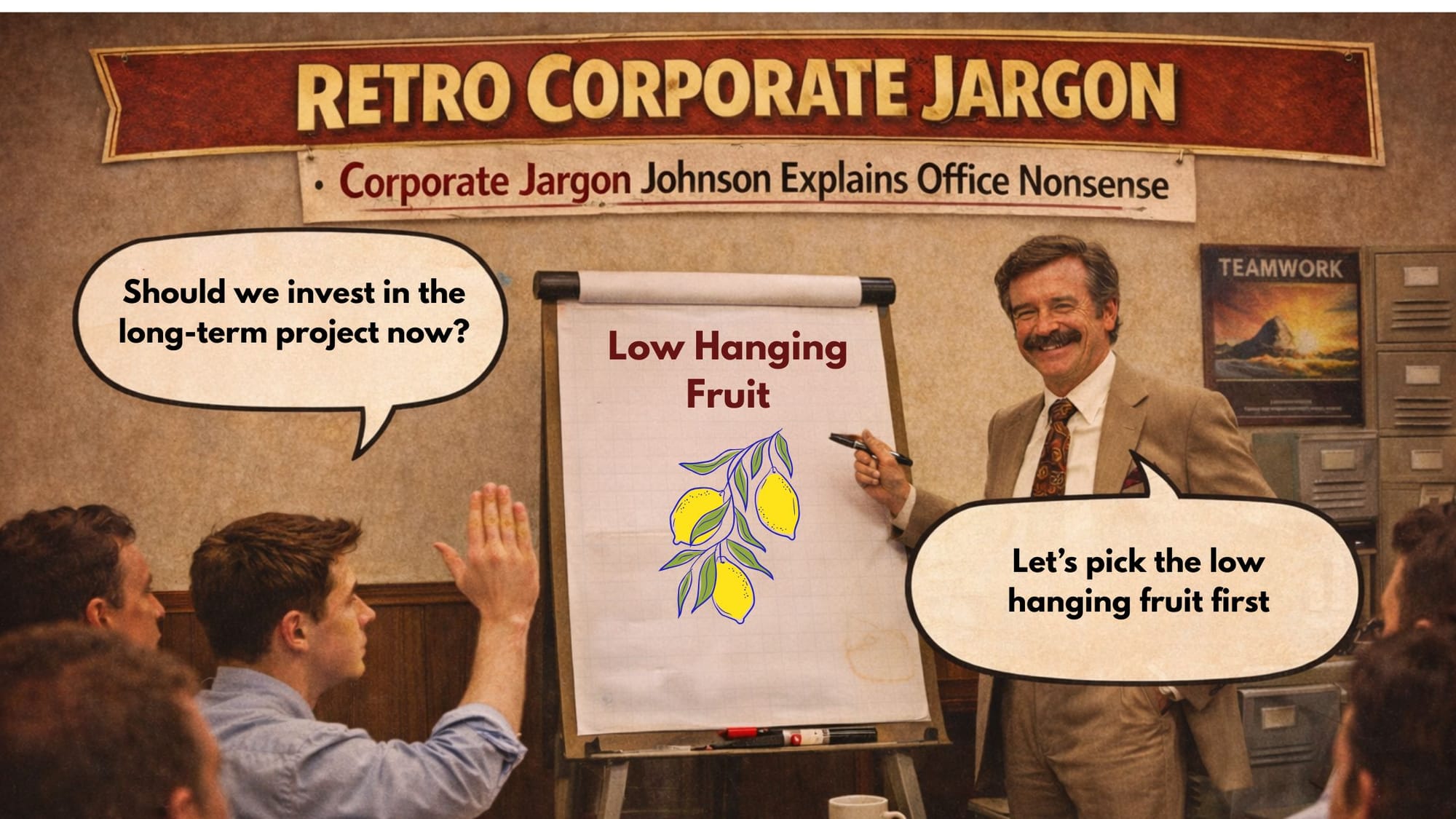
An employee raises their hand nervously.
“Should we invest in the long-term project now?”
Corporate Jargon Johnson smiles proudly and gestures at the flipchart.
“Let’s pick the low-hanging fruit first.”
Everyone nods.
The difficult work gets delayed.
Quick wins become the new strategy.
What “Low-Hanging Fruit” Actually Means
In simple terms, “low-hanging fruit” means the easiest tasks or opportunities that can be completed quickly with minimal effort.
Originally used in farming and harvesting, the phrase describes fruit that can be picked without climbing or reaching.
In the workplace, however, it has evolved into a strategic buzzword.
It often signals:
- Focus on short-term results
- Avoidance of complex problems
- Pressure to deliver visible progress quickly
- Prioritising convenience over long-term value
Sometimes this is sensible.
Sometimes it quietly limits innovation.
7 Reasons Managers Use The Phrase “Low-Hanging Fruit”
🔴 1. To Show Immediate Progress
Quick wins create the illusion of momentum — even if major issues remain unresolved.
🟠 2. To Reduce Risk
Easy tasks feel safer.
Leaders may prefer predictable outcomes to uncertain long-term investments.
🟡 3. To Meet Short Deadlines
When time is tight, organisations naturally prioritise what can be completed fastest.
🟢 4. To Improve Metrics Quickly
Small improvements can boost performance dashboards and stakeholder confidence.
🔵 5. To Avoid Complex Decisions
Difficult strategic choices require courage.
Focusing on simple wins delays those conversations.
🟣 6. To Build Team Confidence
Early success can motivate teams — provided the bigger goals are not forgotten.
⚫ 7. To Create A Sense Of Control
In uncertain environments, tackling manageable tasks can make leaders feel more in charge.
Where Did The Phrase Come From?
The phrase originates from agriculture and orchard management.
Fruit that hangs lower on a tree is easier to harvest, requiring less effort and fewer tools. Over time, the metaphor was adopted into business language to describe opportunities that are straightforward to capture.
As corporate culture evolved, especially during periods of rapid performance measurement and target tracking, the phrase became shorthand for prioritising ease and speed.
Today, it is deeply embedded in project planning discussions and performance reviews.
Is “Low Hanging Fruit” Still Popular In Modern Workplaces?
Very much so.
Despite being widely mocked in workplace humour and leadership commentary, the phrase remains common in:
- project kick-off meetings
- transformation programmes
- productivity drives
- performance management discussions
Modern organisations often operate under intense pressure to demonstrate quick results. As a result, the language of “quick wins” and “low-hanging fruit” continues to dominate strategic conversations.
Ironically, the phrase’s popularity grows precisely because workplaces have become more complex — not less.
How To Deal With The “Low Hanging Fruit” Strategy
If you hear this phrase frequently:
- Ask how quick wins connect to long-term goals
- Clarify whether difficult tasks are being postponed or planned
- Suggest balancing easy improvements with strategic initiatives
- Document priorities so complex issues are not forgotten
- Keep discussions constructive — challenge the strategy, not the person
Handled properly, focusing on low-hanging fruit can build momentum.
Handled poorly, it can stall meaningful progress.
Who Usually Says It?
In the Office Bantomime universe, this phrase is commonly used by:
- Results-Driven Managers
- Dashboard-Obsessed Leaders
- Transformation Programme Sponsors
- Corporate Jargon Johnson himself
Recognising the archetype helps you predict whether the focus is tactical… or simply convenient.
FAQ — Corporate Jargon “Low Hanging Fruit”
❓ Is focusing on low-hanging fruit always bad?
No. Quick wins can build momentum and confidence — but relying on them alone can delay important long-term work.
❓ Why do organisations prioritise easy tasks?
Because they create visible progress, reduce risk, and help meet short deadlines.
❓ What is the danger of only focusing on quick wins?
Complex problems may remain unsolved, innovation can slow, and strategic goals may drift.
❓ How can employees respond professionally?
By linking short-term tasks to long-term outcomes and asking clear questions about future priorities.
 James Mason
 James Mason
 James Mason