

The Dead Weight: Still Employed Through Sheer Organisational Momentum
Every workplace has one. The employee who survives every restructure, avoids responsibility, and somehow stays employed. Discover the hidden cost of workplace dead weight.

Corporate Label #08 – The Dead Weight
Every office has a high performer.
Every office has a future leader.
Every office has somebody who quietly keeps the place running.
And then there's...
The Dead Weight.
The employee who somehow survives every restructure, every performance review, every budget cut, and every management initiative despite contributing approximately the same amount of value as a decorative plant.
Nobody knows exactly what they do.
Nobody is entirely sure who manages them.
Yet somehow they're still here.
What Is Dead Weight?
Dead Weight is the employee who has mastered the art of remaining employed while avoiding anything that resembles meaningful responsibility.
They're not necessarily bad people.
They're not usually disruptive.
In fact, they're often very pleasant.
The problem is that their workload appears to consist primarily of:
- Looking busy
- Forwarding emails
- Attending meetings
- Avoiding ownership
- Surviving organisational change
While everyone else is rowing the boat, Dead Weight is quietly enjoying the scenery.
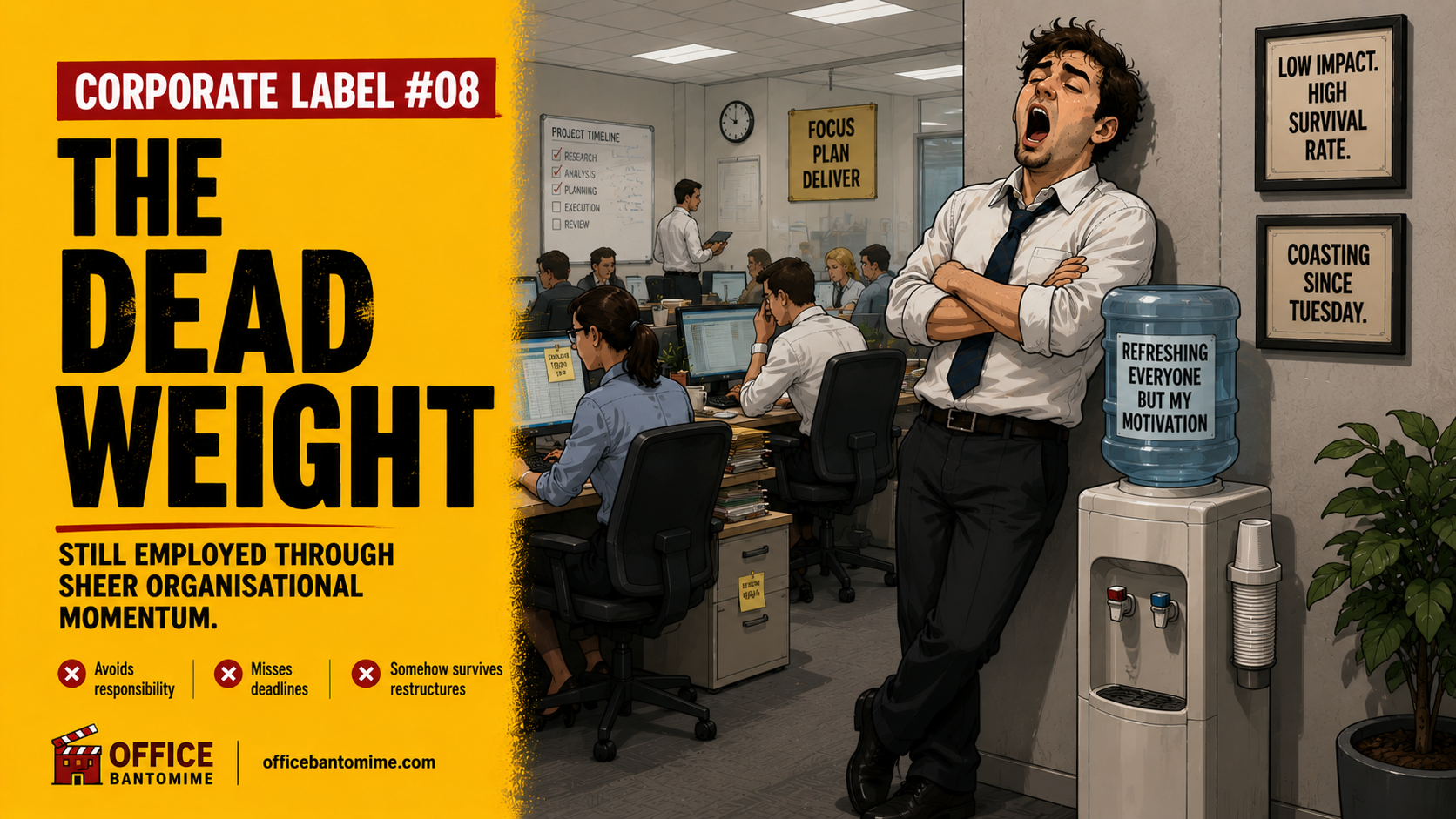
21 Signs You've Found The Dead Weight
1. They are always "just about to start."
2. Every task takes longer than expected.
3. They avoid volunteering for anything.
4. Their calendar is surprisingly full.
5. Nobody can explain their actual contribution.
6. Their biggest achievement happened years ago.
7. They know how to stay invisible.
8. Problems mysteriously become someone else's responsibility.
9. They survive every redundancy programme.
10. Their manager rarely mentions them.
11. They are experts in saying:
"I've been really busy."
12. Nobody has ever seen them rush.
13. They never seem stressed.
14. They always leave on time.
15. Their inbox contains ancient history.
16. They somehow avoid accountability.
17. Every update sounds vague.
18. They contribute very little during meetings.
19. They are always "waiting on something."
20. They are impossible to performance-manage.
21. They outlast everyone.
Why Do Companies End Up With Dead Weight?
Most organisations don't hire Dead Weight.
They create it.
Years of poor management, weak accountability, endless reorganisations, and unclear responsibilities can slowly produce employees who realise something important:
Doing less often carries less risk than doing more.
High performers get more work.
Problem solvers inherit more problems.
Meanwhile, Dead Weight quietly learns the safest place to be is somewhere in the middle where nobody is paying attention.
What Does Dead Weight Cost?
One Dead Weight employee may not seem like a major issue.
Ten of them?
Now things become expensive.
Projects move slower.
Work gets redistributed.
High performers become frustrated.
Managers spend time chasing progress.
Customers wait longer.
Morale drops.
Eventually, the productive employees start asking an uncomfortable question:
"Why am I working twice as hard for the same reward?"
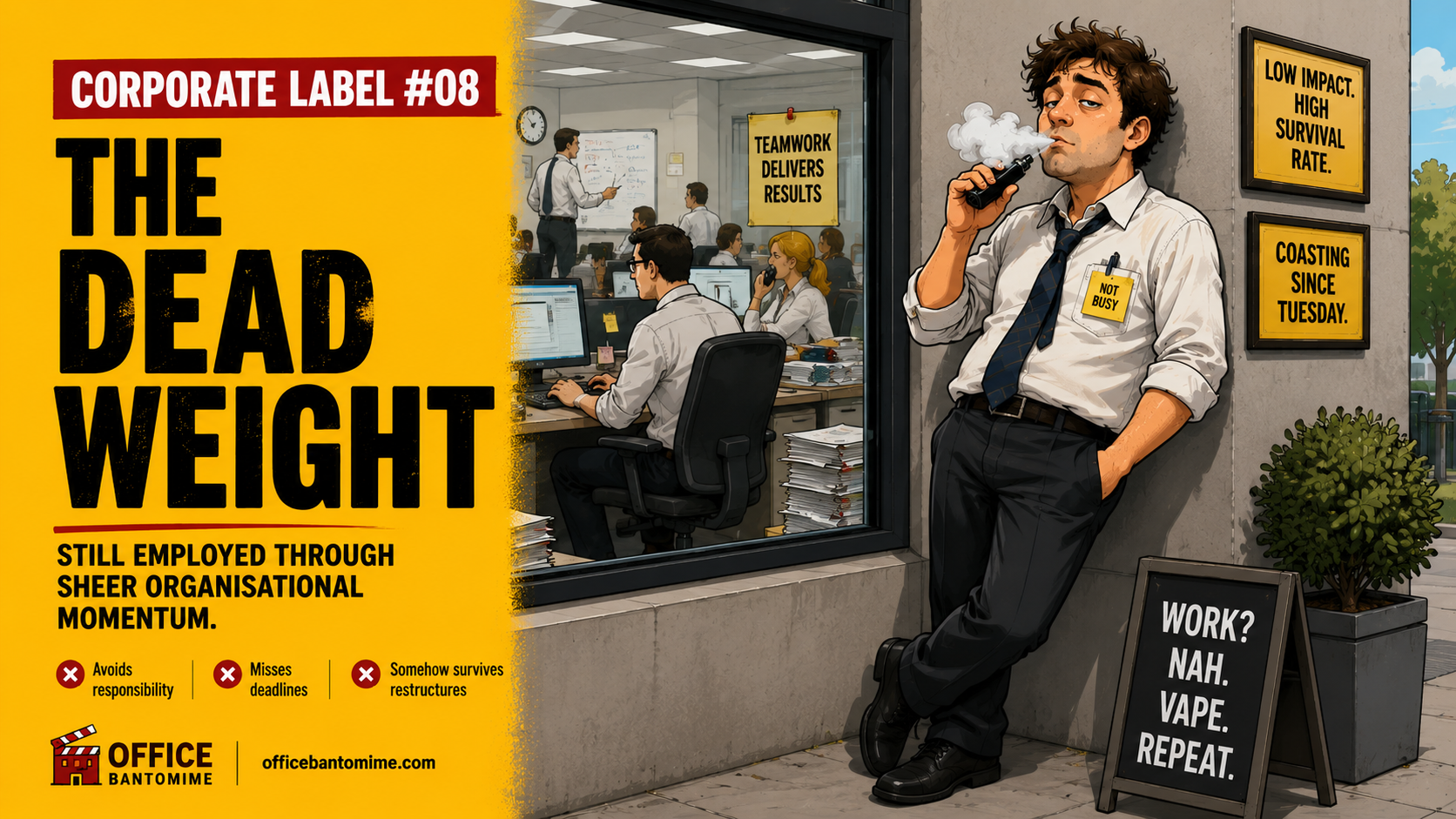
The Great Survival Mystery
Perhaps the most fascinating thing about Dead Weight is their ability to survive.
Companies merge.
Systems change.
Management changes.
Entire departments disappear.
Yet somehow they remain.
Like a corporate cockroach after the apocalypse.
Nobody understands it.
Nobody can explain it.
Everyone secretly admires it.
The Truth
The truth is that Dead Weight rarely sees themselves as the problem.
Most believe they're doing exactly what is required.
And technically...
They often are.
The real issue is usually much bigger.
When accountability disappears, Dead Weight thrives.
When performance standards become unclear, Dead Weight thrives.
When managers avoid difficult conversations, Dead Weight thrives.
In many organisations, Dead Weight isn't a person.
It's a symptom.
How To Deal With Dead Weight
If You Work With One
- Set clear ownership.
- Document responsibilities.
- Follow up regularly.
- Avoid becoming their safety net.
If You Are One
Ask yourself a simple question:
"If I left tomorrow, what would stop working?"
If the answer is:
"Probably nothing."
It might be time for a difficult conversation with yourself.
Final Verdict
Dead Weight isn't usually loud.
They aren't usually toxic.
They're simply there.
Year after year.
Meeting after meeting.
Restructure after restructure.
A permanent feature of the corporate landscape.
Contributing just enough to remain employed while relying on organisational momentum to carry them forward.
And somehow...
Against all odds...
Still appearing on next month's payroll.


