

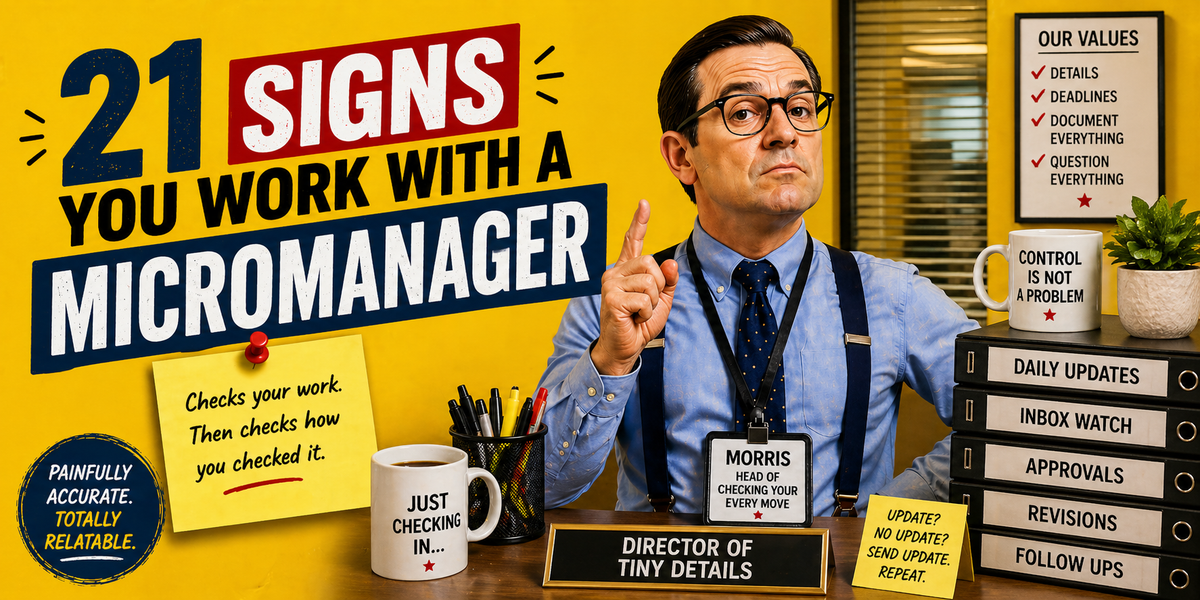
21 Signs You Work With a Micromanager (And You Already Know It)
Working with a micromanager? Discover 21 painfully accurate signs you’re dealing with one—and how to handle them without losing your sanity.

You don’t need to ask if there’s a micromanager in your office.
You already know who it is.
They’re the ones hovering over your shoulder…
Asking for updates before you’ve even started…
And somehow reviewing work that didn’t need reviewing.
They don’t trust the process.
They don’t trust the team.
And most of the time…
They definitely don’t trust you.
Micromanagers are one of the most common workplace personality types. If you’ve ever felt over-managed or constantly monitored, these signs will feel painfully familiar.
You’ll Recognise Them If…
- They ask to review emails before you send them
- They always suggest doing things “their way”
- Their face shows disapproval before they even speak
- They give feedback on everything (whether you asked or not)
- They check your work… then check how you checked it
1. They Want to Check Your Email Before You Send It
You’ve written it. You’re ready to send it.
They still want a look.
2. Their Way Is Always the “Better Way”
Not different. Not an alternative.
Better.
3. Their Face Shows Disapproval Instantly
You don’t need feedback.
You’ve already seen it.
4. Feedback Is Their Love Language
You didn’t ask for it.
You’re still getting it.
5. They Check Your Work… Then Check How You Checked It
Nothing escapes review.
Not even your review process.
6. “Just Checking In…” Happens Daily
And sometimes hourly.
7. Small Tasks Become Status Updates
Nothing is too minor to report on.
8. They Don’t Trust You to Work Independently
Even when you’ve proven you can.
9. They Sit In on Things They Don’t Need To
Just to “observe.”
10. Every Detail Matters… Too Much
Big picture?
Not their focus.
11. They Prefer Control Over Speed
Slower is fine… as long as they’re involved.
12. They Redo Work Instead of Letting You Own It
It’s quicker for them.
Worse for everyone else.
13. They Ask for Approval on Everything
Even things no one else cares about.
14. Meetings Become Inspections
Less discussion.
More evaluation.
15. Delegation Comes With Monitoring
You’ve got the task…
But not the freedom.
16. They Want Updates Before Progress Exists
“What’s the update?”
“I’ve just started.”
17. Everything Feels Urgent
Even when it isn’t.
18. Praise Comes With a Correction
“Good job… but…”
19. They Question Decisions That Don’t Matter
And ignore the ones that do.
20. You Feel Watched
Even when they’re not around.
21. You Feel Managed… Without Them Being Your Manager
That’s when you know it’s bad.
What a Micromanager Is Really Like
A micromanager doesn’t think they’re controlling.
They think they’re maintaining standards.
Where you see a finished task…
They see something that needs refining.
Where you see progress…
They see risk.
And where you see independence…
They see something they need to keep an eye on.
Why Micromanagers Exist
Micromanagement usually comes from pressure—not power.
Most micromanagers are:
- Afraid something will go wrong
- Under pressure from leadership
- Used to controlling outcomes
- Lacking trust in others (or the process)
The problem is…
Their behaviour slows everything down and quietly drains confidence from the team.
You outlast them… or learn how to work around them.
How to Deal With a Micromanager (Without Losing Your Mind)
1. Get ahead of them
Send updates before they ask. It reduces their need to chase you.
2. Show your thinking
Explain decisions upfront so they don’t feel the need to step in.
3. Create controlled visibility
Let them feel informed—but not in control of every detail.
4. Don’t fight every battle
Pick the moments that matter. Not everything is worth pushing back on.
5. Stay calm and consistent
The more reliable you are, the less they feel the need to interfere.
❓ Frequently Asked Questions
What is a micromanager?
A micromanager is someone who closely monitors and controls how work is done, often focusing on small details rather than trusting others to deliver results.
Are these signs based on real coworkers?
Yes—these are inspired by real workplace behaviours that most people will recognise instantly. If it feels familiar, it probably is.
How do you deal with a micromanager?
Communicate clearly, provide updates early, and show confidence in your decisions. The goal is to reduce their need to step in.
Will more Office Archetypes guides be added?
Yes—this is part of a growing series covering the most recognisable (and frustrating) workplace personalities.
Is a micromanager always a manager?
No—micromanagement is a behaviour, not a job title. Sometimes the worst offenders aren’t even your boss.
 🗄️ CONFIDENTIAL DRAWER
(Open Carefully)
This is where most people get stuck… and burned out.
“Yeah… this one drains you slowly.”
🗄️ CONFIDENTIAL DRAWER
(Open Carefully)
This is where most people get stuck… and burned out.
“Yeah… this one drains you slowly.”
💎 If this post hit a bit too close… this part actually matters.
Micromanagement doesn’t always look aggressive — but it creates constant pressure.
It’s the checking, the rechecking, the small corrections, the lack of trust… over and over again.
You’re not imagining it.
Here’s the bit most people don’t realise:
You don’t fix micromanagement by working harder.
Most people respond by over-delivering, over-explaining, and trying to remove every possible doubt.
But that often makes the cycle worse — because it feeds the need for control.
Instead, shift your approach:
- ✔ Set clear expectations early
- ✔ Communicate proactively (before they chase)
- ✔ Show progress — without inviting constant input
You’re not trying to satisfy every check — you’re reducing the need for them.
And once the pressure drops, so does their grip.
- Don’t over-explain — keep updates clear and structured
- Anticipate questions — answer them before they’re asked
- Create visibility — reduce uncertainty
- Keep boundaries — you don’t need to respond instantly to everything
- Stay steady — consistency builds trust over time
Micromanagement doesn’t disappear overnight — but it becomes manageable once you control the flow of information.
If this feels familiar… you don’t need to carry all that pressure.
👉 Know Someone Like This?
Share this with a colleague who’ll recognise them instantly.
 James Mason
 James Mason
 James Mason
 James Mason
👉 New to Office Bantomime?
Start with our most popular workplace guides:


