
Meet the Office Dinosaur: The Coworker Who Hates Change (and Email)
Meet the Office Dinosaur — the coworker who hates change, fears new technology, rejects modern ideas, and drains every brainstorming session with “we’ve tried it before.” A painfully relatable workplace archetype.


New Starters vs The Office Dinosaur
If you are a new starter and get assigned to work with the Office Dinosaur, unfortunately, you are not in for a magical mentoring experience.
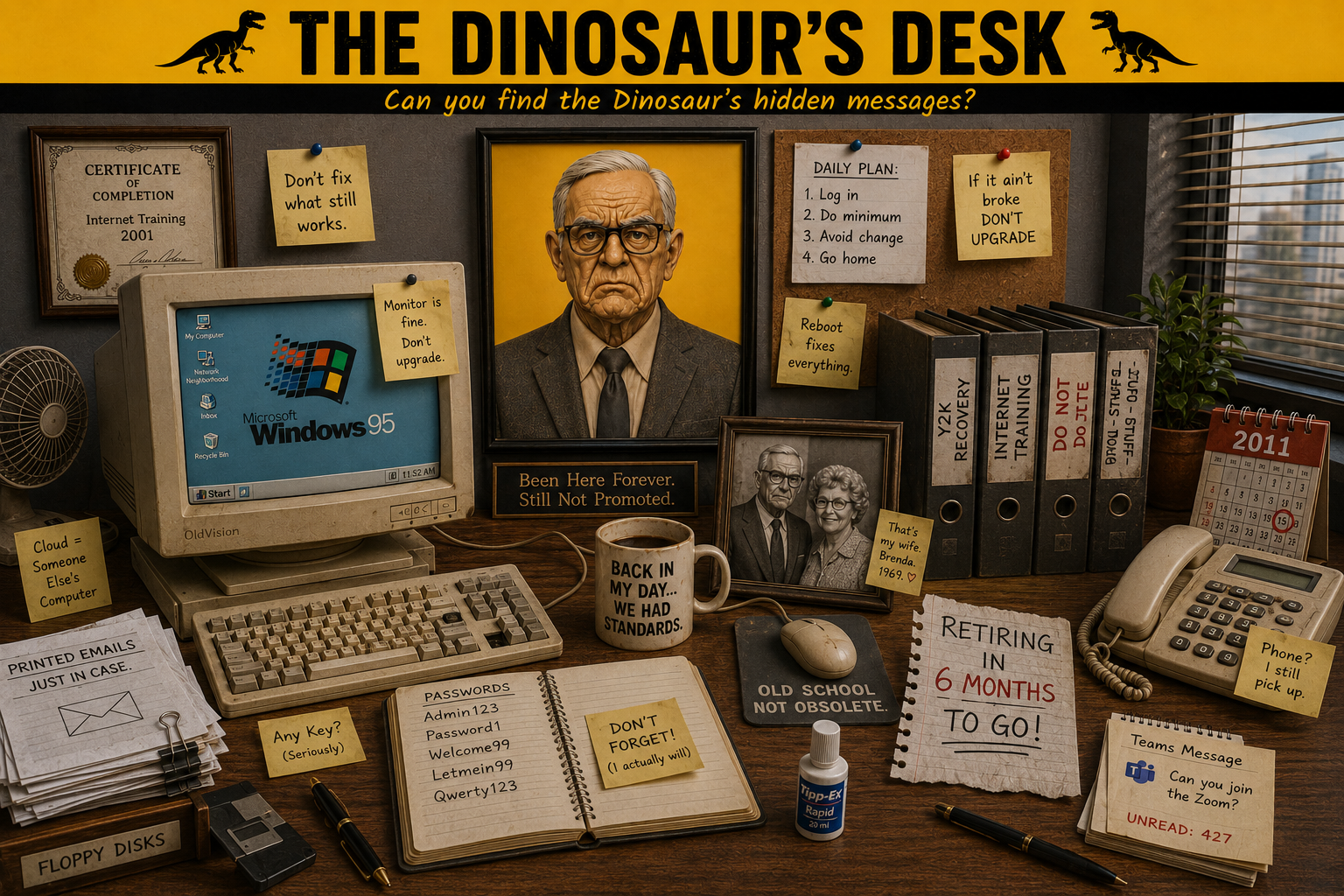
The Dinosaur
The office veteran who remembers every system, every outage and every manager who promised “transformation”.
Windows 95 Machine
Apparently it still works, which means nobody is allowed to replace it. Ever.
Don’t Fix What Still Works
The Dinosaur’s entire change management strategy, written on one sticky note.
Daily Plan
Log in. Do minimum. Avoid change. Go home. A brutally efficient operating model.
Reboot Fixes Everything
Not always true, but somehow still the first suggestion in every crisis.
Back In My Day
The phrase that signals a 20-minute lecture about standards, respect and how email ruined everything.
Password Book
A full security incident disguised as stationery. Password1 still holding strong.
Printed Emails
Printed “just in case”, filed forever, and never looked at again.
Tippex
For correcting documents, labels, and occasionally history.
Retirement Countdown
Six months to go. Motivation has left the building, but the body still clocks in.
The Office Phone
It rings. He answers. Not because he wants to, but because that’s how work used to happen.
Teams Message
“Can you join the Zoom?” Unread: 427. The future keeps calling. He keeps ignoring it.
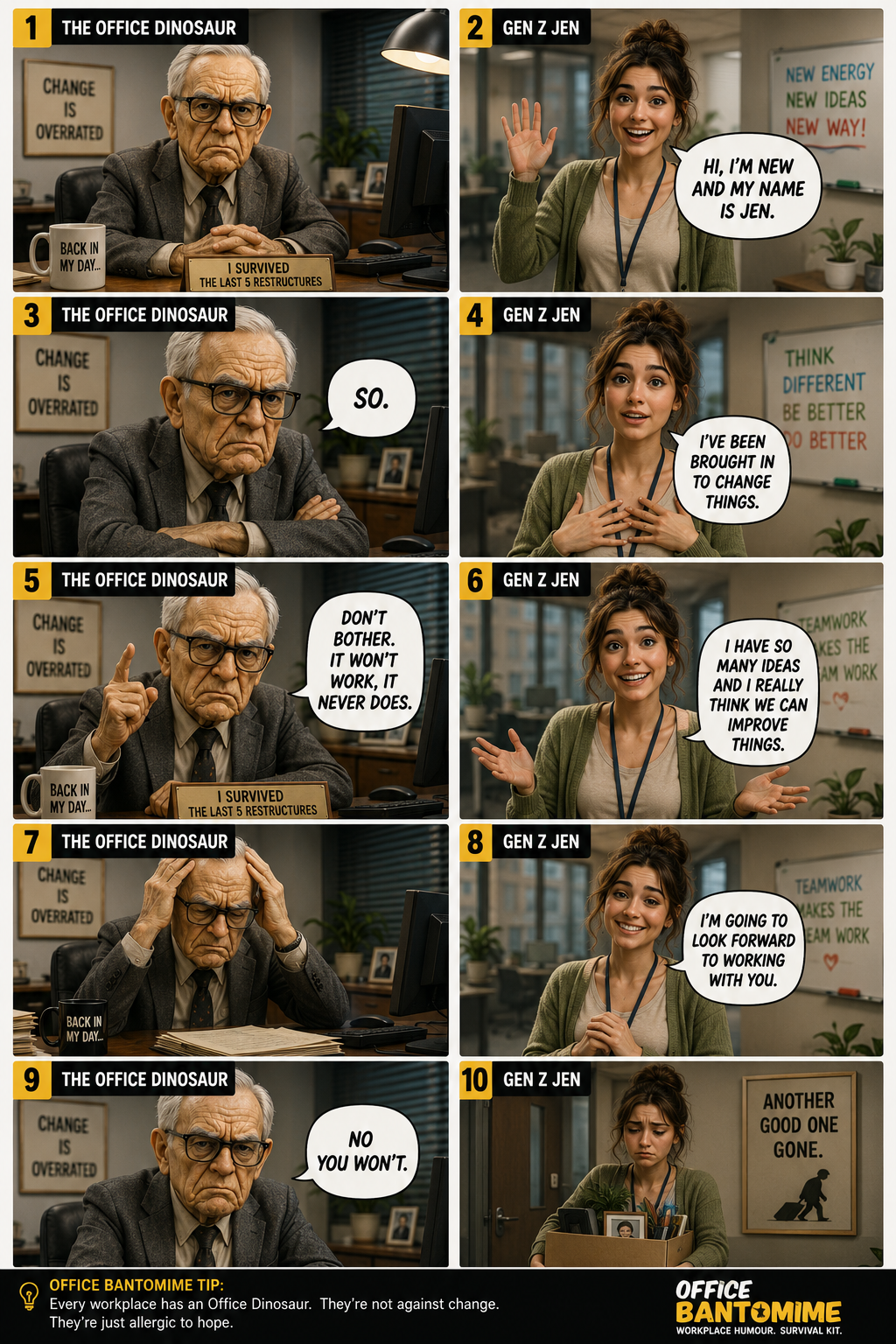
You arrive full of energy.
Motivated.
Positive.
Armed with fresh ideas, modern skills, and enough enthusiasm to power the entire department for six months.
The Dinosaur hates this immediately.
Especially if you are Gen Z.
To him, you are not a promising new employee.
You are a walking disruption to the ancient system he has spent 27 years protecting.
You suggest automation.
He prefers paperwork.
You suggest collaboration tools.
He prefers shouting across the office.
You suggest brainstorming sessions.
He reminds everyone, “We tried that once in 2004.”
The modern workplace terrifies the Dinosaur because it threatens the one thing he still possesses:
Experience.
And he weaponises it constantly.
Every conversation becomes:
“I’ve seen this all before.”
Every new initiative becomes:
“This place changes things every five minutes.”
Every training course becomes:
“Pointless.”
And every team-building exercise is treated like a public execution.
The Office Dinosaur doesn’t want innovation.
He wants stability.
He wants things done the same way they were done when printers weighed more than a family car.
The hardest part for new starters is the slow-draining effect this personality has on morale.
You walk into the business wanting to improve things.
Then, within three weeks, you find yourself saying:
“Maybe we should just leave it.”
That is the true power of the Office Dinosaur.
Not aggression.
Not intelligence.
Not leadership.
Exhaustion.
Because dinosaurs know one thing better than anyone else in the office:
Time.
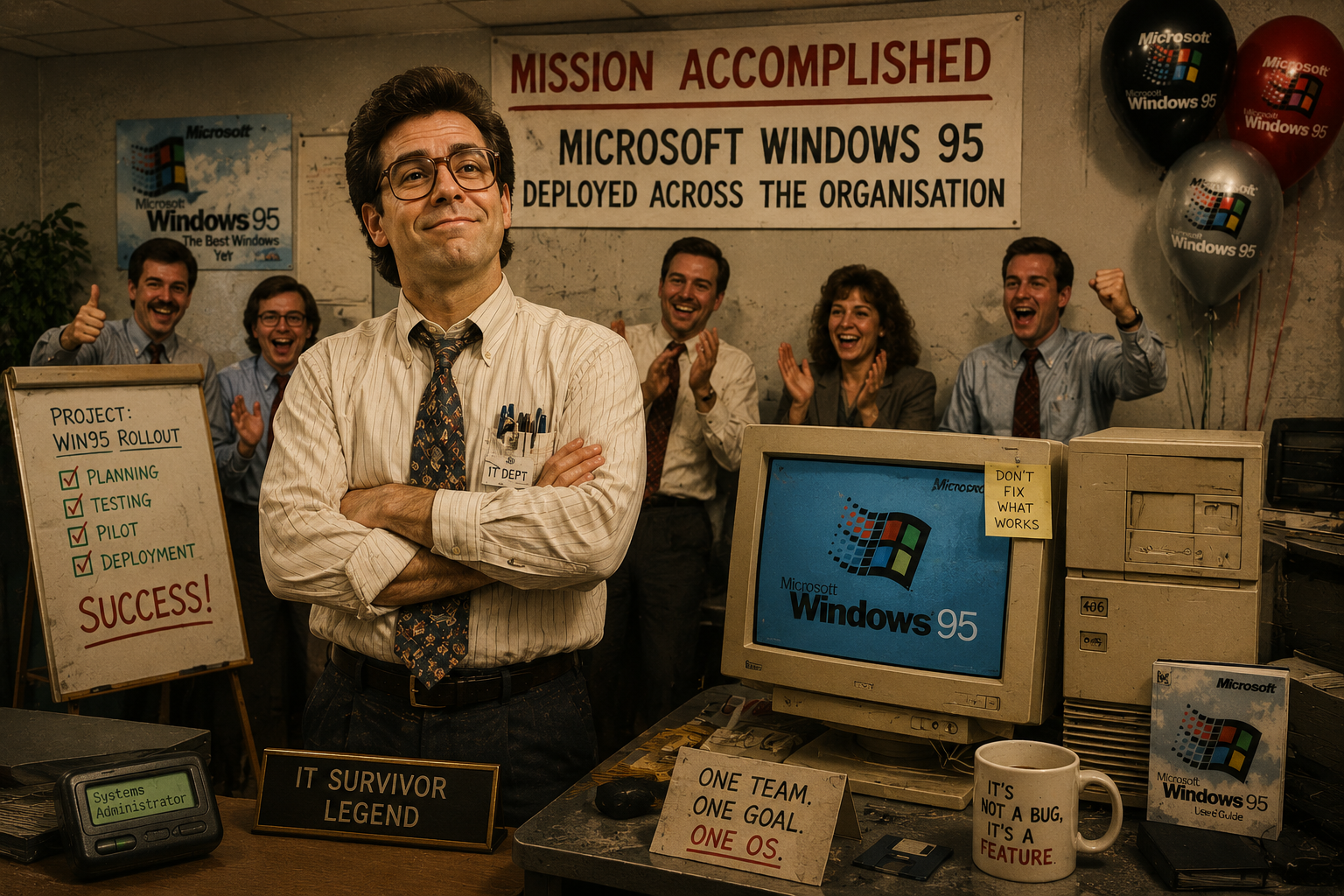
They have survived restructures.
New CEOs.
Five software migrations.
Three redundancies.
Two office relocations.
And at least one failed “digital transformation strategy.”
They know most corporate trends disappear eventually.
So rather than adapt, they wait for everybody else to give up first.
- 1992 Recession
- Windows Vista Rollout
- 8 CEO Changes
- Agile Transformation
- 7 Organisation Restructures
- 10,400 Meetings
- Work From Home
- AI Boom (Still Here)
Classic Dinosaur Behaviours
- Calls younger workers “kids” despite them being 34
- Still prints meeting agendas
- Says “back in my day” at least twice daily
- Thinks hybrid working destroyed productivity
- Complaints modern workers are “too sensitive”
- Uses one finger to type emails
- Refers to Microsoft Teams as “that chat thing”
- Distrusts AI instantly without understanding it
- Thinks every new process is “management nonsense”
- Has survived multiple redundancies because nobody understands what they actually do
Specimen Classification
Final Thoughts
Deep down, the Dinosaur knows the workplace no longer belongs to him.
Technology moved on.
Culture changed.
Communication changed.
And somewhere along the way, he stopped recognising the office he spent his life building his identity around.