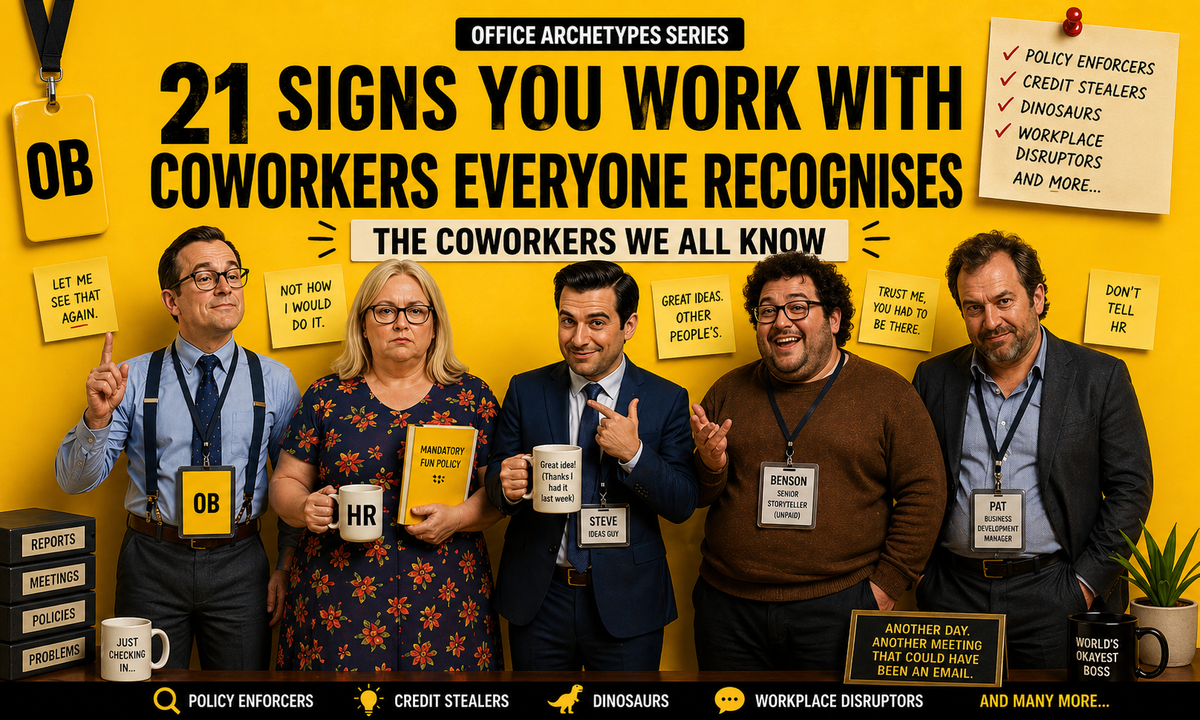

21 Signs You Work With an AI Overuser (Who Lets ChatGPT Run Their Entire Job)
A funny but painfully accurate look at the office AI Overuser — the coworker who lets ChatGPT write emails, solve problems, and practically run their entire job.

Introduction
Every office now has one.
The employee who discovered AI… and never emotionally recovered.
At first, it looked productive.
Then suddenly:
- Every email became suspiciously polished,
- Every document sounded like a TED Talk,
- Every meeting included:
“Let me throw that into ChatGPT quickly…”
…and somehow their entire workload started feeling algorithmically generated.
The AI Overuser is not necessarily lazy.
In fact, many are:
- Efficient,
- Curious,
- Intelligent,
- Genuinely trying to improve productivity.
The problem begins when:
- Critical thinking disappears,
- Verification stops,
- And absolutely everything becomes AI-assisted.
Eventually, coworkers start wondering:
“Do they still know how to do this without prompts?”
Here are 21 signs you work with an AI Overuser.
21 Signs You Work With an AI Overuser
1. Every email they send sounds unbelievably polished
Even messages about printer paper somehow sound executive-level.
2. Their appraisal goals get completed suspiciously fast
Six months of objectives vanish in a single afternoon.
3. AI replies to most of their emails
You can almost hear the prompts behind the wording.
4. “Let me ask ChatGPT” appears in every meeting
Usually, before anybody else finishes speaking.
5. Their writing style changes constantly
Formal Monday.
American Tuesday.
LinkedIn influencer by Friday.
6. They generate documents at terrifying speed
Quantity is never the issue.
7. They suddenly became “strategic”
Mostly because AI learned corporate buzzwords.
8. They ask AI questions they absolutely should know themselves
Including things directly related to their own job.
9. Every idea sounds slightly too perfect
And slightly too generic.
10. They paste huge blocks of text without fully reading them
A dangerous workplace sport.
11. Their productivity appears almost supernatural
Until somebody asks a follow-up question.
12. They become emotionally attached to AI tools
Like proud parents discussing children.
13. They treat prompts like trade secrets
“Prompt engineering” becomes their entire personality.
14. Their meetings are full of AI jargon
Automation.
Optimisation.
Leverage.
Synergy.
Frameworks.
15. They trust AI answers far too quickly
Verification becomes optional.
16. They start sounding less human
Everything becomes oddly polished and strangely emotionless.
17. They use AI to avoid difficult thinking
Particularly around complex decisions.
18. They accidentally submit incorrect AI-generated work
Because nobody checked properly.
19. They believe AI can solve almost anything
Including problems caused by AI.
20. They quietly panic if AI tools go offline
Because the workflow completely collapses.
21. At some point, the whole office notices
The AI is not assisting them anymore.
It’s practically driving the car.
The Truth About the Office AI Overuser
The AI Overuser is usually not malicious.
Most are simply adapting to modern work.
And honestly?
Some become incredibly productive.
AI absolutely can:
- Save time,
- Improve writing
- Accelerate research
- Organise ideas
- Reduce repetitive work
That part is real.
The danger comes when:
- Thinking stops
- Checking stops
- Human judgment disappears from the process.
Because AI is still capable of:
- Hallucinating
- Misunderstanding
- Fabricating information
- Sounding confident while being completely wrong.
Which becomes risky inside:
- Corporate environments
- Regulated industries
- Customer communication
- Operational decision-making
Why This Happens
AI feels incredibly powerful
Because it is.
For many employees, AI suddenly feels like:
- Having an assistant
- Editor
- Researcher
- Strategist
- Copywriter available instantly
That becomes addictive quickly
Workplaces reward speed
Modern business often prioritises:
- Output
- Responsiveness
- Visibility
- Productivity metrics
AI dramatically boosts all four.
Some employees become overdependent
Eventually, the AI Overuser starts outsourcing:
- Writing
- Thinking
- Analysis
- Problem-solving
- Decision-making itself
That is where skill erosion begins.
How to Deal With the Office AI Overuser
1. Don’t automatically assume laziness
Some AI Overusers are genuinely trying to improve efficiency.
The issue is usually overreliance — not bad intent.
2. Encourage verification
AI-generated work should always be:
- Reviewed
- Checked
- Challenged
- Validated
Especially for:
- Customer-facing work
- Technical decisions
- Operational tasks
- Regulated environments
3. Keep human judgment involved
AI should support thinking — not replace it.
The strongest employees use AI as an assistant, not a substitute for competence.
4. Understand the company AI policy
Some businesses have strict rules around:
- Confidential data
- AI-generated outputs
- Intellectual property
- Customer information
Ignoring these creates real risk.
5. Address concerns early if quality slips
If incorrect AI-generated work starts impacting:
- Delivery
- Operations
- Customers
- Team performance
Then, a professional conversation is usually the right first step.
🗂️ Confidential Drawer: The Reality Behind the Office AI Overuser
OPEN CONFIDENTIAL DRAWER
Internal Office Survival Notes: AI Overuser Edition
Click to Open Drawer
The Office AI Overuser is not necessarily toxic.
In many cases, they are simply early adopters trying to maximise productivity.
However, unchecked AI usage can absolutely create risk.
Especially when:
- AI-generated work is not checked properly
- incorrect information slips through
- confidential data is mishandled
- or critical thinking quietly disappears
The biggest danger is false confidence.
AI often sounds extremely convincing even when it is completely wrong.
If AI-assisted work begins affecting:
- quality
- delivery
- customers
- operations
- or compliance
Most situations are solved with a straightforward professional conversation.
Often employees simply need:
- clearer AI guidance
- better review processes
- or understanding of company AI policy
The strongest AI users are not the people who blindly trust AI.
They are the people who know when not to trust it.
Final Office Bantomime Takeaway:
“AI should make work smarter — not make humans stop thinking.”
🤖 Further Signs You’re Working With an AI Overuser
At first it looks incredibly productive. Then you slowly realise the AI is doing most of the heavy lifting.
The Prompt Addict
Every workplace problem somehow begins with “Let me prompt that quickly.”
The Copy-And-Paste Commander
Generates massive documents instantly and hopes nobody asks difficult questions afterwards.
The AI Evangelist
Acts like artificial intelligence personally saved modern civilisation.
The Human Autocorrect
Suddenly rewrites every sentence around them into polished corporate language.
The AI Panic Attack
Becomes visibly distressed the second ChatGPT goes offline.
“The AI Overuser doesn’t just use ChatGPT — they’ve practically added it to the org chart.”
AI Overuser FAQ
What is an AI Overuser at work?
An AI Overuser is a coworker who relies excessively on AI tools like ChatGPT for emails, writing, ideas, analysis, communication, and workplace tasks.
Is using AI at work bad?
No. AI can massively improve productivity and efficiency when used responsibly. Problems usually appear when employees stop checking or critically reviewing outputs.
Can AI-generated work be risky?
Yes. AI can occasionally produce incorrect, misleading, or fabricated information that sounds highly convincing if not verified properly.
Why are employees becoming dependent on AI?
Because AI dramatically speeds up writing, research, communication, and task completion — especially in fast-paced corporate environments.
Should businesses have AI policies?
Absolutely. Clear AI guidance helps protect confidentiality, quality, compliance, and operational accuracy.
How do you manage AI overuse professionally?
Encourage balanced usage, proper review processes, human judgement, and clear understanding of company expectations around AI-generated work.
 James Mason
 James Mason
 James Mason
 James Mason